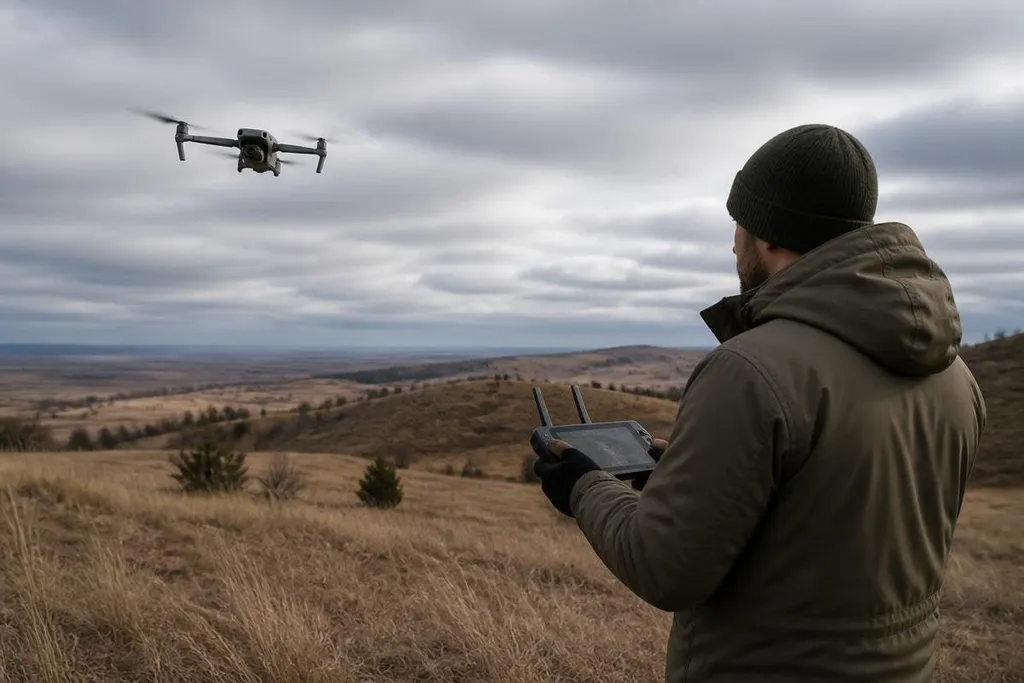
A defense drone can fly well and still fail when its radio link drops, its position signal is blocked, or its camera loses the target. Its performance will be judged by how safely it handles those moments, especially when a person has seconds to decide what happens next.
- Main test: flight and sensing must continue when one input fails
- Human role: operators need clear data, not a wall of alerts
- Open limit: autonomy still needs strict rules for weapons and target decisions
The aircraft is only one part
A defense drone combines an airframe, motors, batteries, sensors, software, and a communications link.
A small multirotor can hover near a fixed point, while a fixed-wing aircraft can cover more ground with less power, but each design gives up something in return.
That trade matters for the job. A hovering aircraft can inspect a bridge or vehicle from one place, while a fixed-wing drone needs space to turn and land. Neither shape solves every task, so the airframe should follow the mission rather than lead the sales pitch.
The sensor package also changes the result. A visible-light camera can show detail in daylight, while a thermal camera can show heat differences at night or through light smoke. An inertial measurement unit tracks motion inside the aircraft, and a satellite position receiver can help it estimate where it is.
Each sensor has a limit. A camera may lose detail in darkness, thermal images may lack useful shape, and satellite signals can be blocked or falsified. Software that compares several inputs can keep the flight plan running, but it still needs a clear way to mark uncertain data.
Autonomy needs a clear boundary
Autonomy means the drone can handle a task without a person steering every movement. That task might be holding altitude, following a route, avoiding an obstacle, or returning to a safe point after a link failure.
Those actions are different from choosing a weapon target. A system can fly to a set point on its own while leaving target approval to a human operator. That boundary should appear in the system design, the training plan, and the record of each flight.
The hard part is the handoff. If a drone makes a route change, the operator needs to see why it changed, what data caused the decision, and what options remain. A short label such as “route blocked” is more useful than a stream of raw sensor readings.
A defense drone’s radio range, route logic, and operator handoff need to be read together. Reporting from Robot24.com can place those details beside a named test or deployment, which matters before communications becomes the next design limit.
Communications will shape the design
A drone that depends on one radio path has one obvious failure point. Future systems will need more than one way to send data, and they may need to keep a basic flight task running when the operator cannot see live video.
That does not mean the drone should make every decision alone. It means the aircraft can hold position, follow a stored route, or return to a planned recovery point while the link is restored. The safe action depends on the aircraft, the area, and the task.
Bandwidth creates another limit. High-resolution video needs more data than a position update, so the system may have to lower image quality or send selected frames when the link is weak. A person making a decision needs enough context, not a perfect video feed that arrives too late.
Cybersecurity belongs in the same discussion. Software updates, access controls, stored maps, and radio settings can affect the aircraft as much as its motors do. A test that checks only flight time leaves out the part most likely to affect control.
What buyers should ask before signing
Teams comparing systems can use this short check before focusing on speed or camera resolution:
- Link loss: What does the aircraft do when control data stops, and how long does that state last?
- Position failure: Can it keep a safe route when satellite positioning is blocked?
- Sensor conflict: Does the system show operators when two sensors disagree?
- Human approval: Which actions need approval, and which can run without it?
- Recovery plan: Where can the aircraft land if the task ends early?
- Evidence: Has the maker shown an uncut test with failures included?
A polished flight clip answers only one part of the buying decision. The useful proof comes from repeated tests that include weak signals, blocked position data, low light, lost video, and a clear record of what the operator saw.
I'd judge a defense drone by its failure handling before its top speed. A machine that returns safely with incomplete data is easier to train, review, and use than one that looks capable until the first broken link.
The next purchase decision should rest on one document: a test record showing what the drone does when its signals, sensors, or operator connection stop working.